Entertainment · KPOP
KPOP is the popular music of South Korea, though the word points to something larger. It sits at the front of the Korean Wave, the name for the worldwide spread of Korean film, television, and music since the late 1990s. What began with one television drama finding an audience abroad grew, over two decades, into a cultural export measured in tens of millions of fans worldwide. Understanding this sector starts here, with a wave a country learned to send outward.
Backed, from the start, as national strategy.
K-pop did not rise by accident. After a financial crisis in 1997 shook the economy, the government looked to culture as a way to earn abroad, and it spent to make that happen. Within a few years the national culture budget had grown several times over, and a 1999 law wrote the promotion of cultural industries into the statute books. Training academies, export agencies, and broadcast quotas followed. From this point on, the wave that began with one drama was a matter of policy.

An idol group is the output of a long production line. Agencies hold open auditions that draw enormous numbers of hopefuls, then take on a small set as trainees, who live and study for years: singing, dancing, language, and how to handle media, often well before any public appearance. One large agency has described narrowing roughly 150,000 applicants in a single year down to about a dozen trainees, and reaching that stage still guarantees nothing, since many never debut. The system is expensive and deliberate.
The trainee pool itself contracted about 38% between 2020 and 2022.
A career managed end to end.
What an agency sells is not only songs. Under one roof it scouts a performer, trains them, records and releases their music, books their tours, places them in advertising, and licenses their image, and it takes a share of the income from each. In the industry this all-in arrangement is compared to a Western 360 deal. The effect is that a single act becomes a bundle of revenue streams, which is what lets the business be read in financial terms at all.
An audience organized like an institution.
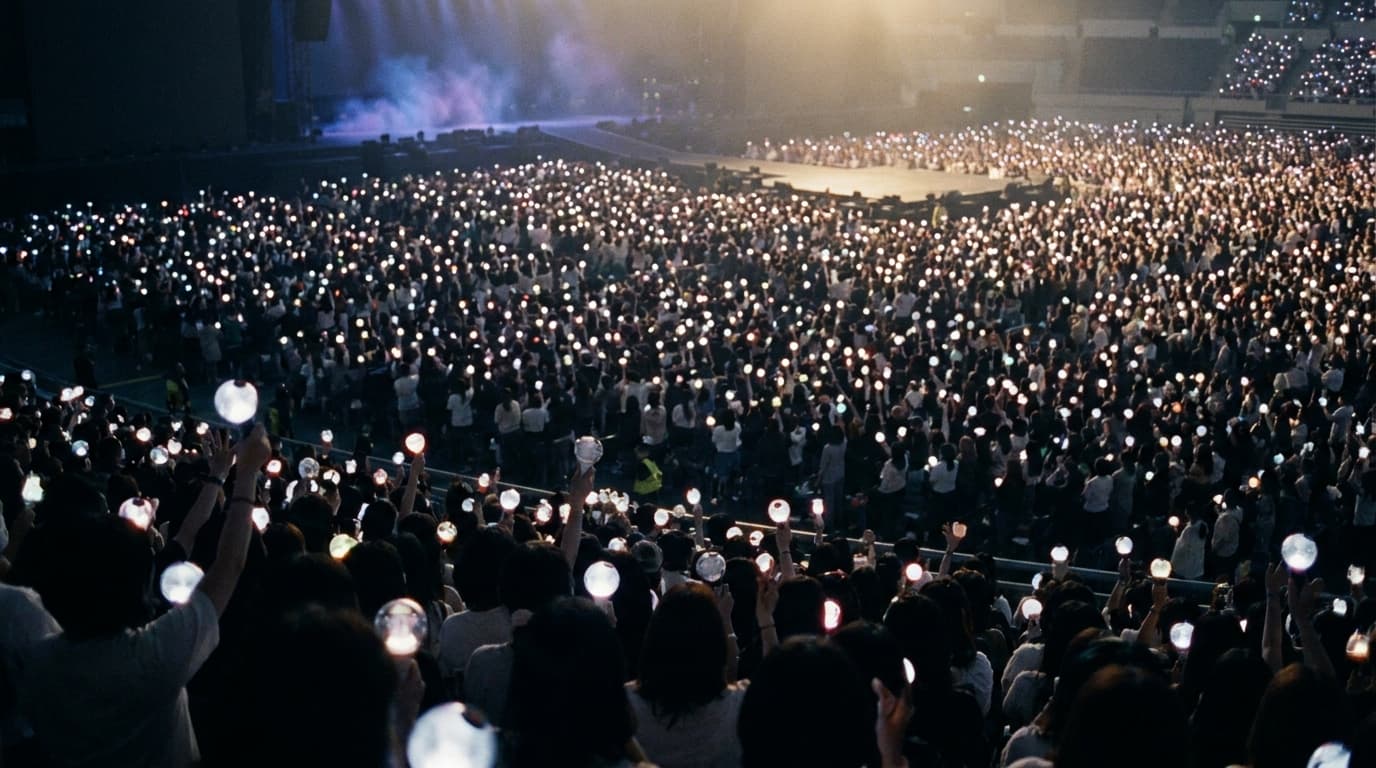
A K-pop fandom behaves as an organized community. Fans form named clubs, coordinate to stream and to vote, fund projects together, and gather on platforms built for them. Counted across the wider Korean Wave, membership of these fan organizations passed one hundred million in 2020, a figure that counts memberships rather than unique people. This organization is part of why the sector holds attention, and spending, at the scale it does.
Most of the world moved to streaming, where listening replaced buying. Korea did too, and its physical album sales still climbed for years. The reason is that a K-pop album is also a collectible: each copy carries photo cards, booklets, and inclusions that fans buy to keep, to trade, and to complete a set. Demand followed the objects themselves.
In 2024 they fell about 19% to 93.3 million, the first decline in nine years.
For most national music scenes, the home country is the largest market. K-pop is unusual. Measured across the top 100 acts in 2023, South Korea placed only fourth in streams, behind Japan and the United States. Its audience is genuinely global. Platform data over five years shows the same shape, with streaming up several times over, and growing fastest in Southeast Asia.
The money in K-pop arrives through several channels at once. In measured overseas sales for 2023, live performance brought in the most, at nearly half the total, ahead of physical albums and streaming. A decade earlier recorded music would have led. Today concerts, tours, and the experience of being in the room carry the largest single share of what the sector earns abroad.

Live performance is now a large business in its own right. A single world tour in 2025 took in about 185.7 million dollars across 31 measured shows, filling stadiums on several continents. Across the whole industry, K-pop reached 7.7 percent of the year's hundred biggest tours, up from 4 percent in 2019. Touring income rises and falls with which major acts are on the road, so it moves in cycles.
The 2024 top ten fell about 25% as major acts ran off-cycle.
Part of what makes the sector visible is its digital scale. When a major group releases a music video, tens of millions watch within hours. One release drew 108.2 million views in its first 24 hours, an independently verified record when it was set in 2021. Records like this are broken often, so the figure is best read as a snapshot: an audience this large can move all at once.

Alongside music and concerts sits a third layer of income that is easy to miss: merchandise, licensing, and the platforms fans subscribe to. At the leading company these together reached about a third of revenue, and it was the only part of the business still growing. Its fan platform, a paid app where members follow and message artists, turned a full-year profit for the first time in 2025. This layer tends to be steadier across the year, which is part of why the industry has leaned into it.
Put together, the numbers describe a real economy. K-pop's overseas sales passed one trillion won for the first time in 2023, and the largest listed agencies each report annual revenue in the hundreds of billions to trillions of won. All of it sits inside the global recorded-music market, worth 31.7 billion dollars and growing for an eleventh straight year. Within that whole, the sector has been taking a rising share.

Because a career is built and owned so tightly, its terms are regulated. A performer signs an exclusive contract with an agency, and Korean authorities set a standard form for these, under which the artist gains the right to leave after seven years. The arrangement is real, though it has clear limits. What an individual actually takes home can be a small and uneven share of what a group earns, once training costs, expenses, and the split among members are counted.
The structure is clearly defined, even where its rewards to the individual stay modest.
An asset class is a kind of thing investors buy to earn a return, like property or bonds. Over the past several years music rights have quietly become one. When a song earns royalties each time it is streamed, played, or licensed, that income can itself be bought and sold, and large investment firms have spent billions doing exactly that. Against 11.75 billion euros collected in global music royalties in a single year, this is the backdrop the whole sector sits inside: a market that already treats recorded music as something to hold.
A frame the state already sets.
Step back, and a shape appears. The demand is already worldwide, and it no longer rests on any single channel of income. The rights beneath it are traded as assets by some of the largest investors there are. The whole arrangement runs inside contracts and standards a state has written down. Every piece of this is measured, drawn from the record as it stands.
Returns come from the curve, not the bet.
A few names carry the rest.
Ranked largest to smallest, revenue in a world like this one does not taper. It collapses onto a few. That concentration is the asset, structural to this kind of revenue and not incidental to it, and its shape is what Orykto is built to hold. Modeled as a power law in rank, illustrative, not to scale.
Held one name at a time, a shape like this is a gamble on which name runs. Held together as a book, each name's downside sits beneath the surplus the curve produces, so no single name can break the whole. The book spreads the fall and holds the tail. What was variance in one name becomes structure across the book, and a conservative floor rests there, on the spread and not on a promise.
At the floor, in the middle, and at the tail, the same book carries three readings.
The model reads the band down, conservatively, from the operating partner's settled record since 2019, the record it is drawn from, and against the shape of the sector above. Modeled, not guaranteed, and can be missed. Each pool sets its own figures.
The pools